


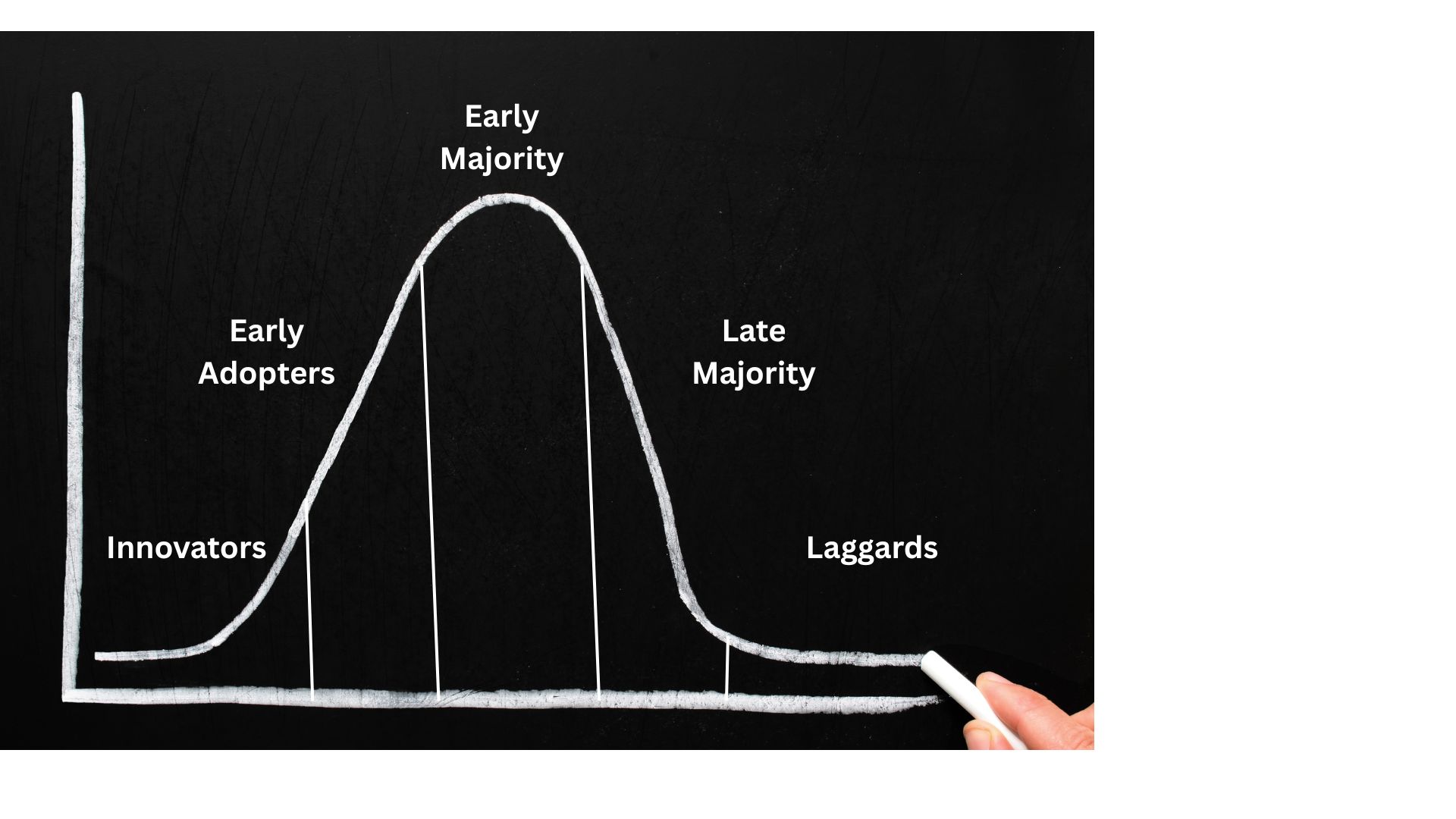
Most companies talk about the Innovation Adoption Curve as if it’s only a marketing or product problem.
In reality, it’s often a sales talent and sales process problem, too.
Over the last few years, I’ve noticed something in coaching calls that I only recently connected directly to the Innovation Adoption Curve.
Some reps are incredibly effective when the market is driven by excitement, innovation, and relationships. Others thrive when the market matures, and buyers become more risk-conscious, process-focused, and operationally skeptical.
The mistake many companies make is assuming the same type of rep naturally thrives across every stage of market maturity.
Sometimes they do.
Often they don’t.
And when leadership hires or manages salespeople as though every stage of the market requires the same selling behavior, frustration follows.
Reps struggle to gain traction. Margins compress. Sales cycles drag out. Leadership questions the strategy, pricing, or effort level of the team.
Meanwhile, the rep may simply be mismatched to the reality of the market they are now selling into.
The issue is not always motivation or work ethic.
Sometimes it’s that the market evolved faster than the sales organization did.
The Innovation Adoption Curve Changes the Sales Motion
The Innovation Adoption Curve explains how markets adopt new products, services, and ideas over time.
Typically, the curve progresses through:
- Innovators
- Early Adopters
- Early Majority
- Late Majority
- Laggards
What many organizations miss is this:
As the market matures, the buyer changes.
And when the buyer changes, the sales approach must change too.
That means the type of rep you need changes as well.
Stage 1: Innovators and Early Adopters
This is where personality, vision, and possibility dominate.
At this stage, buyers are often excited by:
- Competitive advantage
- New ideas
- Innovation
- Speed
- Transformation
- Being first
These buyers tolerate imperfection.
They know the process may not be fully refined.
They’re buying potential.
The Best Reps in This Stage
The reps who thrive here are often:
- Visionary
- Highly persuasive
- Entrepreneurial
- Comfortable with ambiguity
- Passionate evangelists
- Relationship-oriented
- Big-picture thinkers
These reps are exceptional at helping buyers imagine what could be possible.
They create excitement.
They generate momentum.
They help customers emotionally connect to the future state.
In many companies, founders themselves are the best early-stage salespeople because their belief and conviction are contagious.
But these same reps often become frustrated later.
Why?
Because eventually the market changes.
Stage 2: Crossing Into the Early Majority
This is where many organizations struggle.
The buyers become less emotional and more practical.
The questions shift from:
“Could this change our business?”
To:
“How exactly will this work?”
And:
“What happens if something goes wrong?”
The Early Majority is not buying novelty.
They’re buying reduced risk.
This is where process starts to matter more than personality.
Different Industries Sit in Different Places on the Curve
One thing that makes this framework especially useful is that industries — and even product categories inside the same company — may sit in different places on the adoption curve.
Traditional commercial printing, for example, is largely a mature Late Majority market. Buyers often believe multiple providers can produce similar outputs, which shifts the conversation toward:
- Reliability
- Communication
- Workflow (streamlining processes)
- Ease of doing business
- Pricing pressure
- Vendor consolidation
That’s why relationship-only selling becomes risky in mature print markets.
If the primary differentiator is simply that the customer likes the rep, the account becomes vulnerable whenever procurement gets involved, competitors undercut pricing, or another vendor appears operationally easier to work with.
But other areas of the print and marketing industry sit in very different places on the curve.
Web-to-print portals, workflow automation, personalized direct mail, environmental branding, and strategic promotional products still feel much closer to the Early Majority stage.
Not because the categories are new, but because many buyers are only beginning to understand their larger business impact.
Today, buyers are increasingly connecting these services to:
- Employee engagement
- Brand consistency
- Workflow efficiency
- Recruiting and retention
- Customer engagement
- Administrative drag reduction
- Omnichannel marketing effectiveness
That changes the sales motion.
The rep is no longer simply selling output.
They are helping buyers rethink process, engagement, workflow, and operational effectiveness.
And that requires a very different kind of sales conversation.
Stage 3: Early Majority and Mature Markets
In mature markets, competitors start looking similar to buyers.
That’s especially true in industries where services converge over time.
Everyone appears to:
- Offer similar products
- Use similar language
- Promise similar outcomes
- Claim strong service
- Compete on speed and pricing
When buyers feel like everyone does everything, differentiation gets harder.
This is where many companies keep hiring charismatic “hunter” personalities when what they actually need are disciplined business problem solvers.
The irony is that many of these charismatic reps were incredibly successful earlier in the company’s growth.
In less mature markets, their ability to build excitement and relationships may have been exactly what the business needed.
But once the market becomes crowded and buyers grow more cautious, relationship strength alone is no longer enough.
The Best Reps in Mature Markets
The strongest reps in mature markets are often:
- Highly consultative
- Operationally aware
- Process-oriented
- Strong listeners
- Skilled at discovery
- Able to uncover hidden costs and friction
- Comfortable navigating complexity
- Strong at multi-threading relationships
- Effective at quantifying business impact
These reps understand something critical:
In mature markets, buyers are often not looking for dramatic innovation.
They are looking for:
- Lower risk
- Easier implementation
- Better communication
- More consistency
- Reduced administrative drag
- Fewer mistakes
- Better alignment between teams
- Predictability
- Accountability
That changes the conversation.
The Real Shift: Selling Transformation vs. Selling Confidence
Early-stage selling is often about transformation.
Mature-market selling is often about confidence.
That confidence comes from:
- Clear processes
- Reliable communication
- Operational consistency
- Expertise
- Problem anticipation
- Strategic guidance
- Reduced friction
One of the notes I recently sent to a client captures this shift well:
“In a mature market with many competitors, relationship-driven reps struggle. Marrying a strong sales process with relationship-building skills is required when the market is in the Early Majority and Late Majority.”
That’s the transition many organizations fail to recognize.
The rep who thrives when buyers are excited by “possibility” is not always the same rep who thrives when buyers are evaluating operational risk.
Why Some Great Reps Suddenly Struggle
This misunderstanding creates a lot of unnecessary frustration.
A rep who once looked unstoppable may suddenly struggle in a mature market.
Leadership assumes:
- The rep got lazy
- The market changed too much
- Compensation is the problem
- Prospecting activity is the issue
But sometimes the real issue is this:
The market evolved faster than the sales organization did.
The company and the rep are trying to win with an early-stage sales motion in a mature-stage market.
What Mature-Market Buyers Actually Want
In mature markets, buyers increasingly value reps who can:
- Understand internal operational realities
- Identify hidden inefficiencies
- Reduce administrative burden
- Coordinate across departments
- Improve workflow consistency
- Help align sales promises with operational execution
- Minimize implementation pain
- Reduce switching risk
That’s a very different skill set than simply being charismatic.
And it’s why some organizations accidentally hire “relationship reps” when what they truly need are business advisors.
The Best Sales Organizations Build Both
The strongest organizations usually don’t rely on one type of seller.
They intentionally build teams with different strengths.
They understand:
- Some reps create momentum
- Some reps build trust through expertise
- Some reps drive adoption through vision
- Some reps win through operational clarity
- Some reps thrive in ambiguity
- Some reps thrive in structure
All of those profiles can be valuable.
But only if leadership aligns them with the right market conditions.

0 Comments